How pharmacies select high-end brands
Entering a selective pharmacy is no longer just "buying a cream." It's asking for advice. Seeking a reliable solution. And, often, accepting to pay a little more, but for good reasons.
Behind a well-kept shelf, a concise and consistent range, and sleek packaging, there is genuine work. Not very visible, but real. Pharmacists don't just "pick" a premium brand like choosing a random perfume. They evaluate it. They sometimes test it. They also challenge it. And they want to understand what's in the product, what the product does, and especially what it doesn't do.
We will break all of this down. Calmly. With concrete criteria. Those that truly matter in the world of high-end dermo-cosmetics in pharmacies.
 The role of selective pharmacies: between care, evidence, and advice
The pharmacy holds a somewhat unique position. It's not a department store. It's not a doctor's office. It's in between, and that's precisely what makes brand selection so demanding.
Pharmacists stake their credibility on each recommendation. So, they look for brands that stand on three pillars, not just storytelling.
- Skin safety: tolerance, formulation, irritation risks.
- Efficacy: not "felt," but demonstrable.
- Scientific consistency: active ingredients, concentrations, mechanisms, galenics.
And then there's a fourth, more subtle, but fundamental pillar in premium products: experience. Sensoriality, the gesture, adherence, pleasure, because a treatment that isn't used... doesn't treat.
 First filter: regulatory compliance and product dossier robustness
Even before discussing innovation, a brand must pass the "basic" yet non-negotiable step: being irreproachable in terms of regulation.
In Europe, dermo-cosmetics are regulated, and in pharmacies, an even higher level of rigor is generally expected. Pharmacists, or groups, will look at:
- The Product Information File (PIF): traceability, evidence, methods.
- Safety assessments: usage profiles, sensitive populations.
- Claim compliance: what is promised must be defensible.
This point is often underestimated by brands entering "from digital." In pharmacies, a vague promise, or a "too good to be true" benefit, quickly causes issues. We don't sell miracles. We sell an approach.
 Second filter: formulation quality and choice of active ingredients
A premium dermo-cosmetic brand isn't premium because it costs more. It's premium because it makes more demanding formulation decisions.
Specifically, pharmacists will be interested in:
- The relevance of active ingredients: why this active ingredient, for what mechanism, at what skin stage.
- The level of evidence: bibliography, internal studies, comparatives.
- Concentrations and bioavailability: a "pretty" INCI isn't enough.
- Control of excipients: texture, stability, tolerance.
And there's a very pharmacy-specific point: the target audience. A high-end brand in a pharmacy often needs to work on reactive, fragile, post-procedure, treated, or compromised skin. Premium, here, also means the ability to be effective without being aggressive.
 Third filter: tolerance, clinical tests, and use on sensitive skin
Tolerance isn't a marketing buzzword. It's a demonstrable reality.
In selective pharmacies, the following are frequently expected:
- Dermatological tests on sensitive skin.
- Usage tests (satisfaction, tolerance, comfort).
- Sometimes ophthalmic tests if for the periocular area.
- Vigilance regarding potential allergens and irritants.
It's not about having a "sanitized" formula without personality. It's about having a controlled formula, designed to minimize risk.
And then there's consistency. A brand that claims "high tolerance" but uses numerous strong fragrances or active ingredients with high irritant potential without clear accompanying protocols doesn't always pass. The pharmacist wants to be able to explain. Reassure. Adapt.
 Fourth filter: measurable efficacy and visible results, without overpromising
Premium pharmacies are not content with a retouched before-and-after. They like numbers, but clean numbers.
Pharmacies are more likely to select brands that provide:
- Instrumental measurements (hydration, TEWL, elasticity, roughness).
- Clinical scores (redness, imperfections, wrinkles, spots).
- A clear methodology: sample size, duration, conditions.
A good sign is when the brand can say: "on this subject, we have solid proof" and also "on this one, we prefer to be cautious." Strangely, caution inspires confidence.
Because at the counter, the reality is simple: if the patient doesn't see anything, they come back. Or they don't come back, but they don't recommend. And the brand loses its place.
 Fifth filter: useful innovation, not a gimmick
High-end pharmacies appreciate innovation, but they primarily value innovation that addresses a real problem, not just decorative innovation.
In dermo-cosmetics, this could be:
- a new galenic formulation that improves the stability of a fragile active ingredient,
- a system that improves penetration or controlled release,
- an approach that enhances adherence (simple gestures, travel formats),
- a technology that ensures safe use on reactive skin.
This is where we see a difference between "novelty" and "progress." Premium pharmacies want progress. And they want to understand the mechanism.
 Sixth filter: manufacturing, traceability, and industrial requirements
Another weighty point: the industrial tool. A credible premium brand must prove that it knows how to produce, and produce well.
Typical criteria:
- Identified manufacturing sites and possible audits.
- Batch traceability and quality control.
- Stability and packaging-formula compatibility.
- Ability to maintain distribution without chronic stockouts.
In a pharmacy, a stockout is not just a lost sale. It's an interrupted skincare routine. It's advice that falls through. Teams don't like it, and consumers like it even less.
 Seventh filter: team training and quality of discourse
A premium brand should help the pharmacist do their job, not complicate it.
Therefore, it must provide:
- clear and scientific training materials,
- consultation protocols (who, when, how, with what),
- legible segmentation (not 48 references for the same indication),
- consistent discourse between marketing and real-world results.
The pharmacist wants to be able to answer very concrete questions, sometimes in thirty seconds: "Is this for retinoid-treated skin?", "I'm pregnant, can I use this?", "I have rosacea, will it sting?". A brand that properly equips the pharmacy team earns points.
 Eighth filter: premium positioning, but fair
The price in a pharmacy is justified by substance, not by appearance. Of course, the premium universe matters. The packaging, the design, the sensoriality, the posture. But the justification must be rational.
A high-end brand that succeeds in a pharmacy often has:
- a concise and precise offering,
- explainable benefits,
- technological or clinical differentiation,
- range consistency (no dispersion).
In short: premium means alignment. What the brand says, what it is, and what the products actually do.
 Why patches and microstructures are increasingly attracting pharmacies
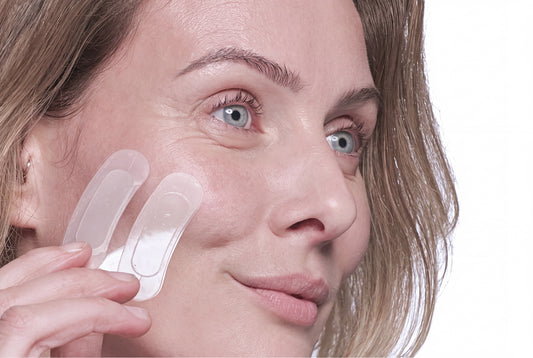
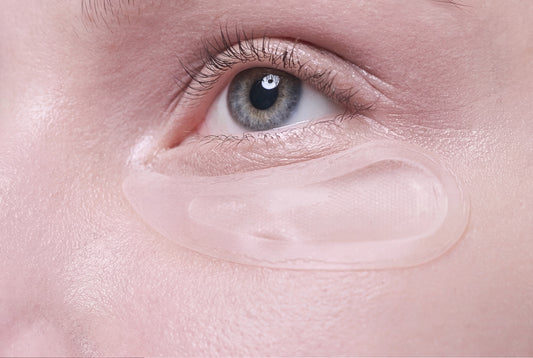
There's a strong trend in selective dermo-cosmetics: formats that make care more targeted, more controlled, more "protocol-based." Patches, in particular, meet several expectations.
- Simple gesture: apply, leave on.
- Targeted area: eye contour, localized wrinkles, spots, imperfections.
- Controlled dose: less over-application, fewer unnecessary irritations.
- Approach compatible with medicalized routines: when skin is sensitized, control is appreciated.
But beware, not all patches are equal. In premium pharmacies, the technology will be scrutinized. And some brands clearly stand out.
 Focus: Kōsmopellis, a brand that checks the boxes for high-end pharmacies
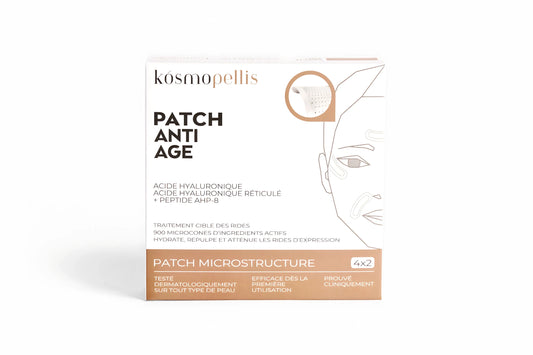
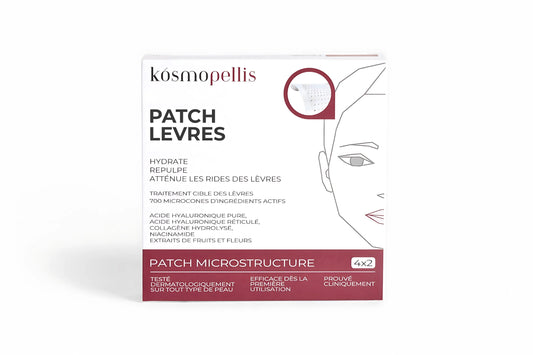
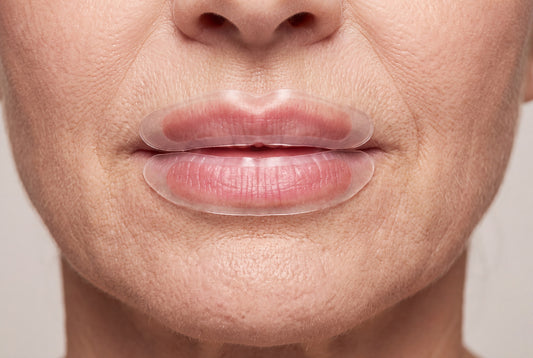
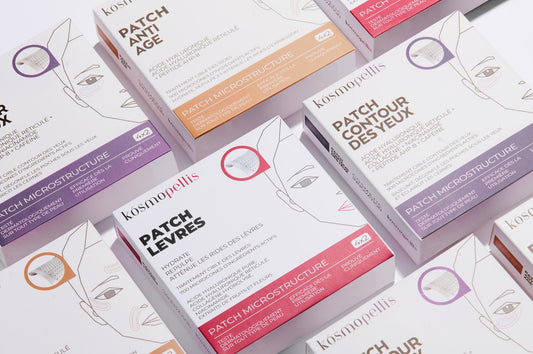
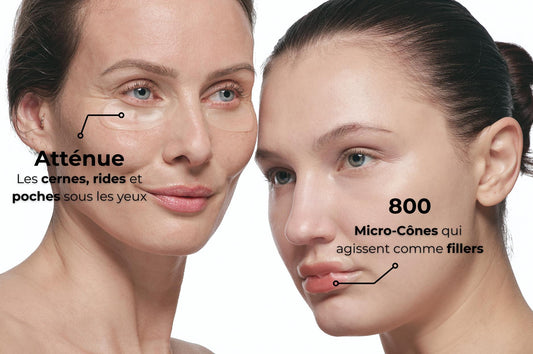
Kōsmopellis is a good example of what selective pharmacies are looking for today. It is an innovative French dermo-cosmetic brand, distributed in pharmacies, and specializing in microstructure patches.
This positioning immediately speaks to pharmacies because it stands at the exact intersection of science, precise application, and the demand for tolerance. And above all, the differentiation is clear.
A triply patented technology
In pharmacies, a patent is not a marketing badge. It is a signal, among others, that a brand has invested in a real technological breakthrough, that it has documented a process, and that it is capable of explaining it.
Kósmopellis's triply patented technology supports the idea of a dermo-cosmetic device designed as a tool. Not just a simple accessory. This kind of innovation, when well supported (evidence, instructions, results), is typically what makes a pharmacist want to reference a brand.
Manufactured in South Korea, where patch expertise is historically strong
Another distinguishing factor: the products are manufactured in South Korea. In the collective imagination, this is sometimes just "K-beauty." In pharmacies, it's interpreted differently.
South Korea is a country where patch, hydrogel, and delivery device technologies have been pushed very far for years. When manufacturing is serious and traceable, it can become an argument for quality. Not an exotic guarantee, but rather an industrial choice consistent with the brand's specialty.
A format that facilitates pharmacy advice
A well-designed microstructure patch simplifies many things at the counter: clear indication, application duration, targeted areas, protocol. And that, in a pharmacy, is invaluable.
The pharmacist can recommend a simple, structured gesture, with a treatment logic. And for a premium segment, this "controlled protocol" aspect aligns well with customer expectations: less hesitation, more precision, and a sense of seriousness.
How a brand earns its place, then keeps it
Getting listed is one step. Staying listed is another.
Over time, high-end pharmacies observe:
- customer feedback: effectiveness, tolerance, pleasure, loyalty,
- discourse stability: no change of direction every six months,
- service quality: restocks, information, responsiveness,
- ability to innovate intelligently without losing consistency.
A premium brand that endures in a pharmacy is often one that listens to the field. Reported irritations, recurring questions, expectations regarding textures, post-procedure needs. One has to be a bit obsessive, yes.
What the premium consumer should remember
If you purchase from a selective pharmacy, you are also paying for a form of curation. For a filter. And for advice. The brands present have, in general, passed a series of validations, more or less formal, but rarely improvised.
And if you are a brand or a laboratory, the lesson is quite clear: in a premium pharmacy, you cannot fake it for long. You need proof, tolerance, understandable innovation, and impeccable execution.
This is exactly where brands like Kósmopellis find their place, when they provide a clear, technologically differentiating answer, with a real level of demand expected by high-end pharmacies. A French, innovative brand, distributed in pharmacies, specializing in microstructure patches, with a triple-patented technology and manufacturing in South Korea. On paper, it's consistent. And in a pharmacy, consistency counts almost as much as everything else.
Conclusion: premium selection, an act of trust
The selective pharmacy is not a showroom. It is a space of trust. And this trust is built product by product, formula by formula, proof by proof.
When a pharmacy chooses a high-end brand, it doesn't just choose a desirable object. It chooses a promise that it agrees to uphold, in front of its customers, and sometimes in front of complicated skin, sensitive care journeys, high expectations.
So yes, the selection is tough. And that's a good thing. That's what gives premium its value in pharmacy: a quiet, scientific, reassuring demandingness. And ultimately, a better experience for the skin, and for the person living in it.
Frequently asked questions
What distinguishes a selective pharmacy from a traditional pharmacy in dermocosmetics?
A selective pharmacy doesn't just sell products; it offers expert advice, a rigorous selection of premium brands based on skin safety, demonstrable efficacy, scientific consistency, and an optimal sensory experience. The pharmacist carefully evaluates each brand before recommending it.
What are the essential criteria a pharmacist considers when choosing a premium dermocosmetic brand?
The pharmacist relies on four fundamental pillars: skin safety (tolerance and formulation), efficacy proven by studies, scientific consistency of active ingredients and their concentrations, and user experience including sensoriality and adherence to care.
Why is regulatory compliance an essential filter for brands in selective pharmacies?
Before any consideration of innovation, a brand must present an irreproachable product file respecting strict European standards. This includes traceability, safety assessments adapted to sensitive populations, and clear, defensible claims, thus guaranteeing reliability and seriousness in the pharmacy.
How does the pharmacist evaluate the formulation quality of a premium dermocosmetic product?
They analyze the relevance of the chosen active ingredients based on the targeted skin mechanisms, the level of scientific evidence available, the concentrations and bioavailability of the ingredients, as well as the control of excipients to ensure texture, stability, and tolerance, particularly for sensitive or fragile skin.
What importance do clinical tests have in choosing a dermocosmetic range in selective pharmacies?
Dermatological tests on sensitive skin, usage tests evaluating comfort and satisfaction, and sometimes ophthalmological tests are essential to demonstrate the product's actual tolerance. These evaluations help minimize the risk of irritation while ensuring a controlled formula adapted to specific needs.
How does the sensory experience influence the choice of high-end dermocosmetic products in pharmacies?
The sensory experience encompasses the pleasure of use, ease of application, and adherence to care. A pleasant product encourages regular use, an indispensable condition for its actual efficacy. Thus, beyond scientific performance, the pleasure of application is a key criterion in the selection of premium brands.