Why 80% of your skincare stays on the surface (and how to fix it)
You've had that slightly frustrating feeling before, after applying a "high-end" cream or serum... as if your skin drank it all up. And at the same time, a few hours later, you wonder what really changed.
Pleasant texture, light fragrance, softer skin in the moment. But for spots, fine lines, firmness, deep radiance... it's sometimes slow. Very slow.
What if the problem wasn't you? Or even your routine? But just... the way the active ingredients get in, or rather, don't get in.
Because in reality, a large part of classic skincare stays on the surface of the skin. Literally.
What no one really tells you about skincare "penetration"
We talk a lot about "concentration." About "15% Vitamin C." About "pure retinol." About "next-generation peptides." But there's a more basic, almost embarrassing question.
How many of these ingredients actually get to where they need to act?
The skin is a barrier. An excellent barrier, even. That's its job. It protects against dehydration, pollution, aggressions, and also against... everything you try to put on it.
The outermost, toughest layer is the stratum corneum. A bit like a brick and mortar wall. The bricks are dead cells. The mortar is lipids. Very schematic, but you get the idea.
The result: when you apply a cream or serum, part of it stays on the surface. Another part evaporates. And another part gets lost in translation, shall we say, without reaching deeper layers.
It's not that cosmetics "don't work." It's that they have a physical limit.
And that limit is huge.
Why we can say that 80% of your skincare stays on the surface
So, let's be clear. The exact figure can vary depending on the formula, molecule size, vehicle, your skin, your routine, your environment. But in practice, for a classic application like a cream or serum, it's often estimated that about 30% of active ingredients manage to penetrate effectively.
30%. Sometimes less.
Which means the rest... stays on the outside. On the surface. Where the active ingredient is less stable, more exposed to oxygen, light, and where it can simply be wiped off, transferred to the pillow, or rinsed away.
And that's where the phrase "80% of your skincare stays on the surface" becomes a very telling shortcut. Because in many routines, actual efficacy is limited, not by the quality of the ingredient, but by access.
It's like having excellent coffee... but half of it stays stuck in the filter.
The false good solutions we adopt without realizing it
When we feel things aren't moving fast enough, we often do one of these things:
We layer. Toner, essence, serum, booster, cream, oil. Telling ourselves it will "help." Sometimes it does, sometimes it doesn't. Often, we mainly add... layers.
We increase the concentration. Stronger, higher dosage, more "active." The problem is that stronger doesn't mean deeper. And sometimes, it's just more irritating.
We exfoliate more. To "clear the way." Again, on paper, it makes sense. In real life, too much exfoliation weakens the skin barrier. And a fragile barrier leads to redness, dehydration, sensitivity. Not necessarily the glow you hoped for.
We search for the miracle product. The one that will finally do what others haven't. While we're going in circles around the same obstacle: penetration.
And that's why the real question becomes: how to get active ingredients beneath the surface, in a targeted way, without aggression.
The real crux of the problem: skin doesn't "let things through" easily
We could sum it up like this: skin is designed to say no.
Even with the best active ingredients in the world, if their diffusion is low, the effect will necessarily be limited. And this is even truer when we're talking about specific needs: deep wrinkles, loss of firmness, stubborn dark spots, deeply dehydrated skin.
For some people, this translates into an endless routine. For others, into a silent resignation: "my skin isn't receptive." While often, it's just a matter of application technology.
And that's where one approach changes the game.
How to remedy it: The Kōsmopellis microstructure and its micro-cones of active ingredients
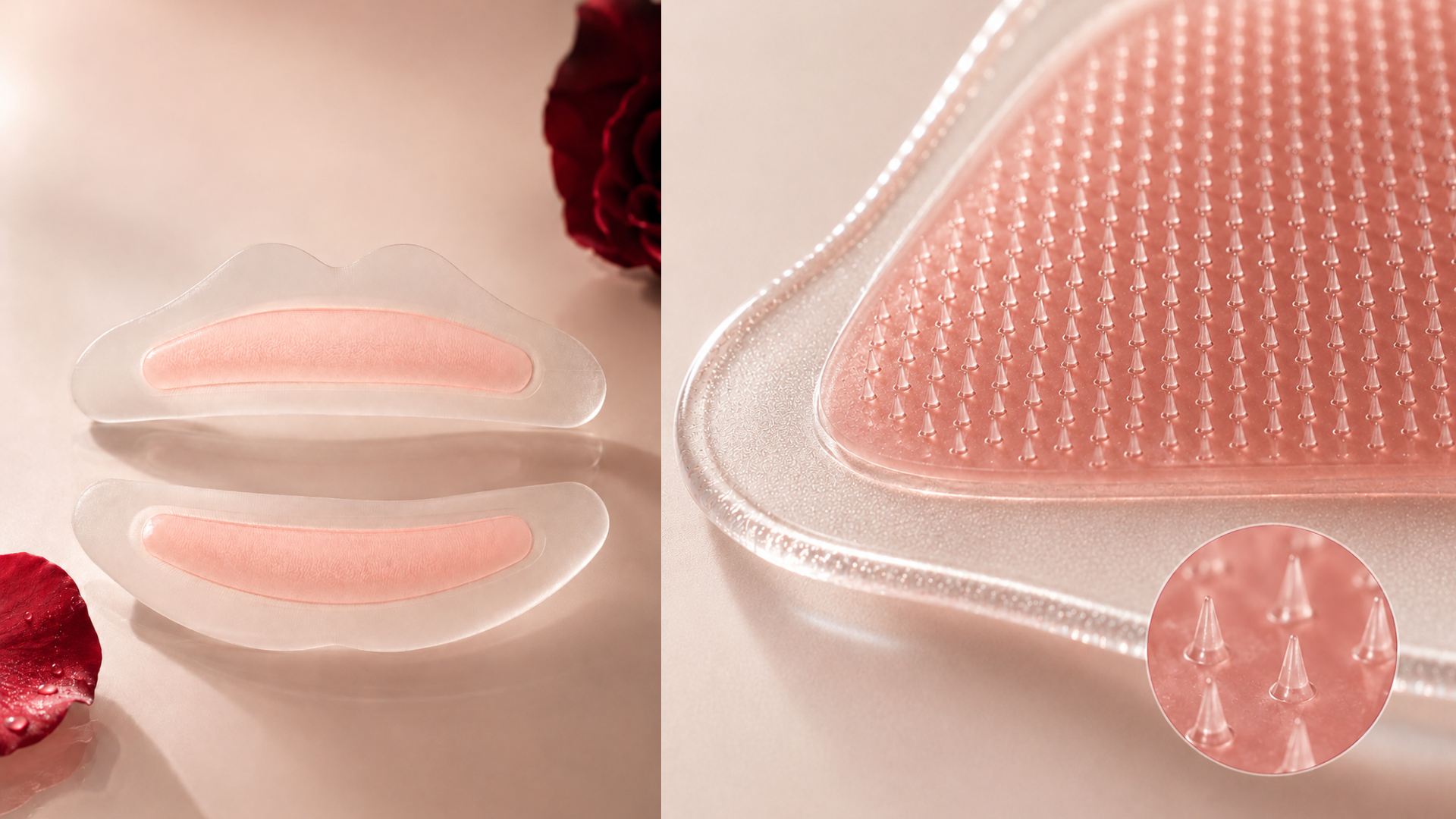
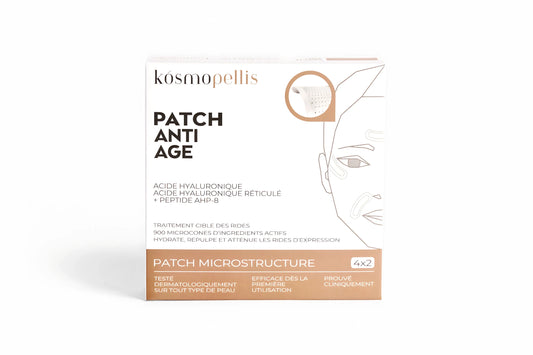
There's a solution that doesn't rely on "putting more," but on "making it penetrate better." The Kōsmopellis microstructure.
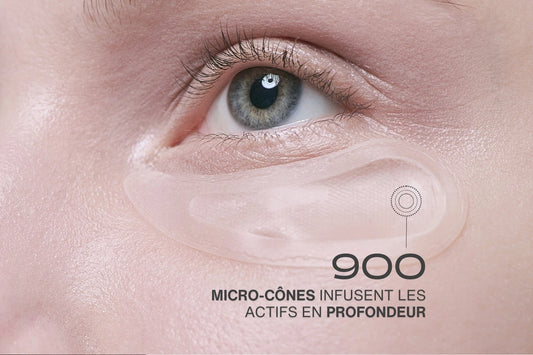
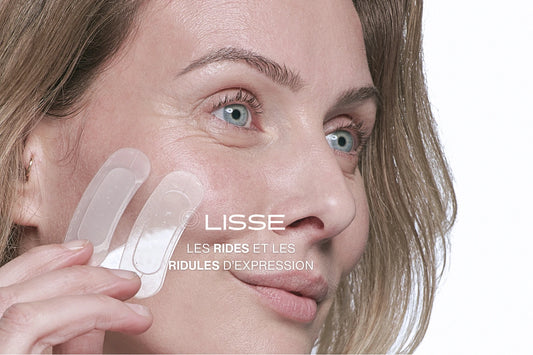
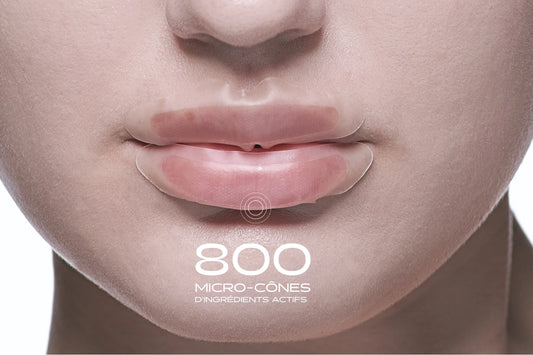
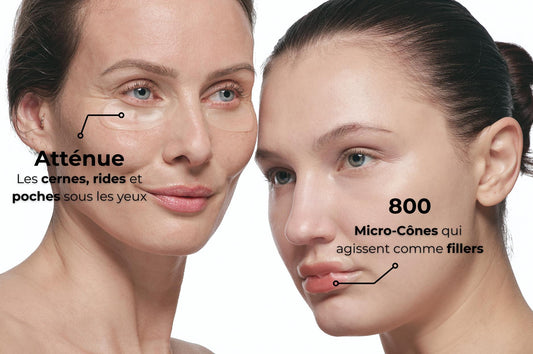
The principle is quite simple to understand, but frankly different from what we know in classic cosmetics: instead of applying active ingredients to the skin hoping they'll penetrate, we use a microstructure composed of micro-cones of active ingredients.
These micro-cones are not metal needles. We're talking about a cosmetic architecture made of active ingredients, structured into micro-cones, which will diffuse beneath the skin. The idea is to place the active ingredient as close as possible to the area where it can be useful, then let it dissolve and diffuse.
And there, we're no longer talking about the same numbers at all.
We're talking about approximately 80% ingredient penetration with this approach, compared to approximately 30% for a traditional product like a cream or serum.
80% versus 30%. The gap is enormous.
And inevitably, when you change this parameter, you change everything else: the consistency of results, the speed at which an effect is observed, and sometimes even tolerance, because you can avoid certain aggressive strategies designed to "force" penetration.
Why not all microstructure or micro-cone patches are created equal
And now, a small but important pause, because this is the kind of detail that prevents disappointment.
Not everything that looks like a "microstructure" patch has the same effectiveness.
Firstly, because the geometry of the micro-cones can vary. The density, size, how they dissolve, the quality of the formulation. Secondly, because the stability of the active ingredients, their actual dosage, and the ability to deliver that dosage consistently... that needs to be tested. It can't be guessed.
And then there's another, simpler point: many products use technical vocabulary without reaching the level of scientific rigor behind it.
That's why Kōsmopellis technology stands out, because it's not based on a vague promise. It's based on studies, it's dermatologically tested, clinically proven, and, most importantly, triple patented.
This combination changes the credibility of the whole thing. We're no longer in "it looks innovative." We're in "it has been measured."
What does it concretely change in a routine?
Simply put: you stop relying solely on the surface.
With a cream, you often get immediate comfort, a feeling of supple skin, a protective film. That's useful, of course. But it doesn't mean transformation.
With deeper diffusion of active ingredients, what you're looking for becomes more attainable. Not overnight, we won't tell tall tales. But more logically, more directly. Because the active ingredient gets there better.
It can also simplify your routine. No need to stack ten steps if the most important step is the one that truly delivers.
And then there's a rather pleasant aspect: you have less of that feeling of "waste." You know, the idea that you're investing in a formula, but part of it ends up on your pillowcase.
Why you often see more results when penetration increases
It's almost mechanical.
Imagine two people using the same active ingredient. The first in a classic cream with 30% effective penetration. The second with micro-cone technology that achieves approximately 80%.
Same active. Same consistency. Same patience.
But not the same quantity delivered where it matters.
This is where some routines suddenly become coherent. Because instead of changing products every two months, you maintain an approach and let time do its work, with real diffusion.
And this is also where discussions change: we no longer talk only about "which active is best," but about "how this active is delivered."
How to recognize serious technology without getting lost in marketing
A few simple benchmarks, without getting into laboratory analysis.
- Proof, not just words: Look for "clinically proven," "dermatologically tested," and ideally information on studies. Not just a slogan on a landing page.
- Patents: It's not an absolute guarantee, but it shows there's real technical innovation. In this case, Kōsmopellis is a triple-patented technology, so we're talking about a high level of engineering and intellectual protection.
- A measurable promise: "80% versus 30%" is a comparison that requires a methodology. It forces robustness. When a brand puts forward this type of figure, you want to see that there's substance behind it.
- Product consistency: If everything is vague, if you don't know what diffuses, how, and why, be wary. Good tech explains itself.
Mistakes to avoid when switching to micro-cone patches
Yes, even with good technology, you can make mistakes. Some common ones:
Trying to do everything at once. Keep your routine as clear as possible, otherwise you'll never know what's working.
Continuing to aggress the skin. If you're using an approach that improves penetration, you don't necessarily need to push exfoliants to the maximum. Always respect the skin barrier.
Thinking that "more often" means "better." It all depends on the recommended protocol. The goal is not to overload, but to deliver correctly.
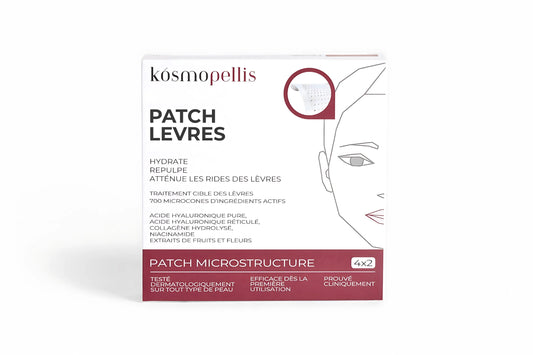
And most importantly, don't buy the first patch you see thinking it's all the same. No. Not all microstructure or micro-cone patches achieve the same effectiveness. That's exactly why we emphasize the technology and the evidence.
So, why 80% of your skincare stays on the surface... and what you can do right now
If your routine consists only of creams and serums, chances are you're limited by the skin barrier. It's not a failure. It's just biology.
And the most logical way to overcome this ceiling, without resorting to an excess of acids and layers, is to use a technology that changes the delivery of active ingredients.
The Kōsmopellis microstructure, with its micro-cones of active ingredients that diffuse beneath the skin, allows for approximately 80% penetration, compared to approximately 30% for a traditional product like a cream or serum.
But keep this sentence in mind, because it matters: not all microstructure or micro-cone patches are created equal. If you want to achieve high results, look for serious technology that is studied, dermatologically tested, clinically proven, and ideally patented. In the case of Kōsmopellis, we're talking about a triple-patented technology.
Deep down, it's almost reassuring. The problem isn't that you're "not doing enough." It's that you were mostly doing it... on the surface.
And now you know how to fix it.